Everyone’s heard about CS skins — even if you’ve never bought a defuse kit or planted a bomb. But for most players, they’re just flashy weapon textures…unless you’ve really gone down the rabbit hole of cosmetic items. In reality, what you see in-game is just the tip of a massive iceberg. Wanna know how simple weapon finishes turned into a $4 B+ market?
I’m Dima Ostroverkhov, Product & Process Manager at MOJAM — a product company used by 5.7 M CS players. In this guide, we’re diving deep into the world of skins. From a few-cent drops to knives worth millions. We’ll break down why people hunt for microscopic scratches on a gun, and why wolves from Wall Street are increasingly eyeing CS “cosmetics” as investments. What’s really behind the hype? And why is a player’s inventory way more than just a bunch of items in Steam? Let’s go 🚀
What Are Skins: a Definition for Rookies and PROs
Simply put, skins are the “outfit” for your weapon or character. They don’t change gameplay — but they make your gear look cooler and help you stand out from the crowd.
Zoom out, and a skin is a digital asset blending aesthetics, rarity, and player psychology. It can signal status, boost perceived prestige, and shape how you’re seen in the community. There’s a full-blown economy based around skins with its own rules and context inside the CS ecosystem — so yeah, it’s way more than just pixels. Today, skins nudge players to spend more time in-game and invest deeper into Counter-Strike. Plus, the skin economy helps enable massive prize pools for tournaments.
Why Did Skins Gain a Cult Status in the CS Community?
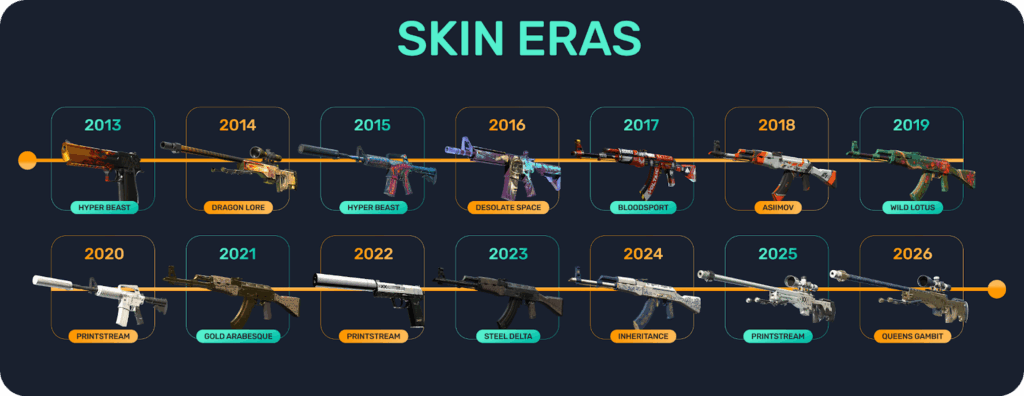
Official skins first dropped as cosmetics in Counter-Strike: Global Offensive back in 2013, and the community picked them up fast. But the hype around unique items started way earlier and just kept going to the moon. Here’s how it escalated:
- Before CS:GO: community creativity era. Skins were born out of pure community energy. Back in the early 2000s (CS 1.6 days), players were already modding the game, creating custom weapon designs and making the experience more personal
- Valve enters the game. In August 2013, the Arms Deal update dropped ~100 skins across 10 collections. That’s when drops and cases became a thing. Today, the community still creates UGC skins, and Valve curates the best ones, pays the creators, and ships them in official releases
- Steam Marketplace changes everything. That’s when the hunt began. Valve introduced a rarity system (from White to Gold) that still defines value today. Skins turned into tradable assets: something you flex, invest in, and chase
- Trading goes beyond the game. Once it became clear that some skins are worth hundreds (or thousands) of dollars, a whole market formed. Third-party platforms popped up where players buy, sell, and trade like it’s a stock exchange
- Skins = CS cultural code. Today, skins are everywhere — esports stages, streams, literally every match you play. Even people who’ve never launched CS have heard about them. At this point, skins aren’t just visuals but a full-on gaming culture phenomenon
Where Can You Get Skins?
Skins can be earned, opened, or bought. Here are the main ways:
- Drops after matches. Each week, CS2 rewards players with cases and skins just for playing actively
- Case opening. You buy a key, open a case, and get a random skin from a specific rarity pool
- Buying on the Steam Marketplace. The easiest way: buy the exact skin you want directly from other players
- Trading with other players. Skins can also be exchanged via Steam or third-party trading platforms
- Events. Souvenir skins can’t be “crafted”; they only drop during official tournaments (like Majors), which makes them valuable as historical artifacts
- Special in-game operations. These skins can’t be found in regular cases, so they automatically become scarce and are often hunted by investors
What Makes a Skin Popular?
When you open a case in Counter-Strike 2, the skin doesn’t just “drop” randomly. Valve has refined the randomness algorithm so that rare skins land in your hands once in a blue moon. This adds even more excitement for collectors, because there’s always the motivation to chase a legendary item.
The algorithm exists to keep skin values stable on the market. However, in reality, rarity alone doesn’t determine which skin becomes a dream item for many players. A great design, float value, texture pattern, and popularity among streamers and PRO players can turn a skin into a community favorite. Best part: it works like that even if an item is not extremely rare.
Why Do Players Buy Skins?
For many outside the hardcore CS community, it’s hard to understand why someone would pay the price of a premium car for a “wrapper” on a weapon. In reality, every player has their own motivation, and it’s not always about money.
It’s a Way to Stand Out in Your Favorite Game
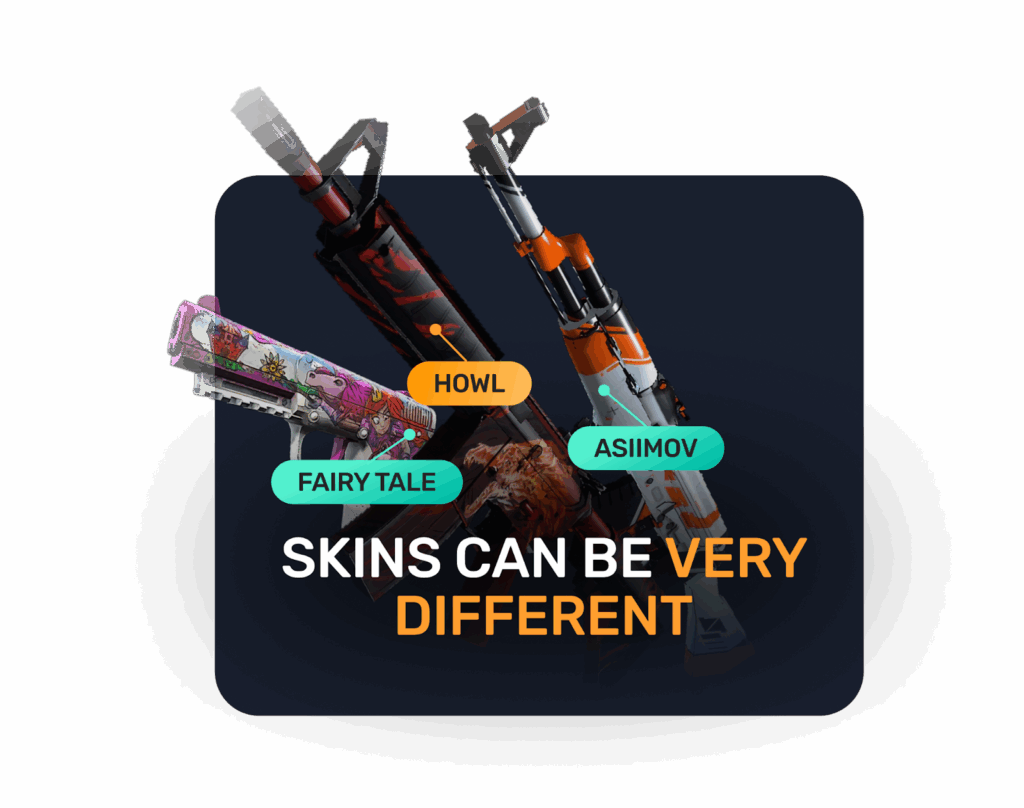
If you spend even a few hours a day in CS, it’s almost impossible to avoid wanting to get a certain skin at some point. Just like clothing in real life, in-game visuals are a way to express individuality. A minimalist Asiimov, a cute Five-SeveN Fairy Tale, and a rugged M4A4 Howl will most likely be chosen by completely different people.
Skins = an Investment
Decorative items in CS are unique because they hold real value beyond the game. Skins are effectively tied to the US dollar across marketplaces. Since the market is global, the price of a rare knife or rifle isn’t affected by local inflation in any single country. For many, this is a way to store value in “digital gold” and to convert it back easily via third-party services.
According to Pricempire, the total value of all skins is estimated at $4.7–$5.8 billion, so it’s no surprise that even people outside gaming are investing in them.
Collecting
Some people collect watches or stamps, while others collect cool CS skins. Hunting for a specific float or a rare pattern ID often becomes a game of its own. Some even create personal quests, like finding a skin that looks factory-new despite visible wear in its stats.
A Proof You’re Part of the Community
A skin shows you’re “in the know.” Rare or iconic skins are often owned by high-ranking players or tournament participants. It’s an instant signal of your experience, status, or just great taste. Pull out an AK-47 Case Hardened with four Titan Holo stickers in-game, and you instantly become the coolest player on the server (plus get a few dozen new friend requests).
Types of Skins You Should Know
Weapon Skins
Weapon skins are the foundation of the entire market. It’s what a player sees in their hands 90% of the time. This whole category can be split into three logical groups:
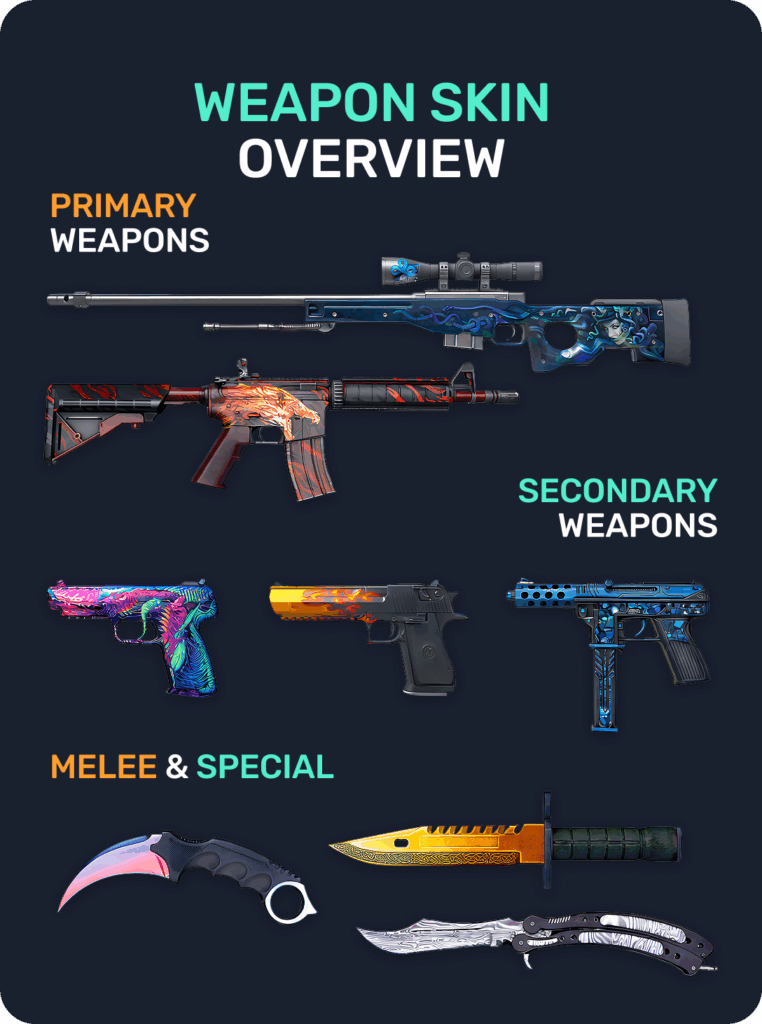
Primary Weapons:
The most expensive and hyped category.
- Rifles (AK-47, M4A4, M4A1-S, AWP, AUG, SG 553, FAMAS, Galil AR). These have the highest demand. Collecting AK skins is like collecting classic cars: they’re always in value
- Sniper Rifles (AWP, SSG 08, SCAR-20, G3SG1). Thanks to the large surface area, artists turn these into actual canvases, which makes them popular among collectors
- Heavy Weapons (Nova, XM1014, MAG-7, M249, Negev). Machine guns and shotguns are considered more “niche” in collecting, so demand here is lower
Secondary Weapons:
Since players get them for free at the start of every round, skins for these weapons are owned by almost everyone.
- Pistols (Glock-18, USP-S, Desert Eagle, P250, Five-SeveN, Tec-9, etc.)
Melee & Special:
Here, the uniqueness of the interaction and the novelty matter most.
- Knives (Karambit, Butterfly, Bayonet, M9 Bayonet, etc.). The key feature of knives is their unique draw and inspect animations. Players often choose them not for the design, but for how cool they look in motion. No surprise, prices start at $100 and go to infinity
- Zeus x27 (Olympus). For a long time, the taser was the only weapon without skins — but in CS2, it finally joined the market. Now it’s also a must-have for a perfect inventory
Cosmetic Items
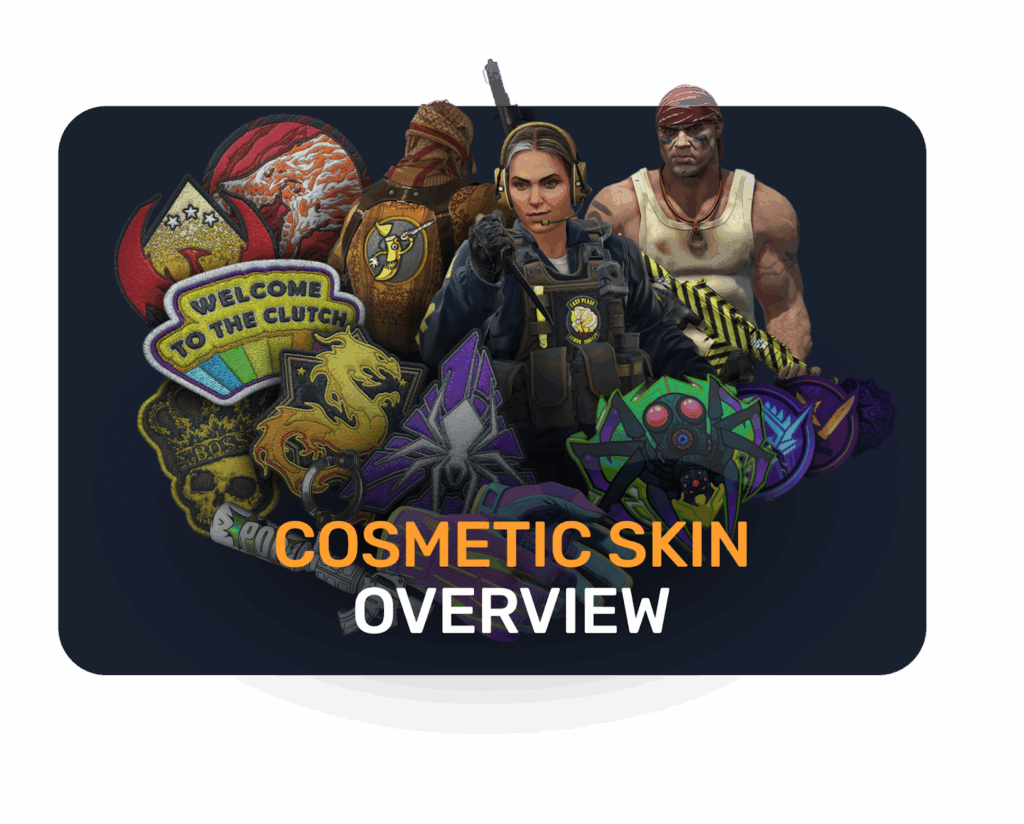
Everything else is simple: any item that isn’t a weapon falls under cosmetics. Here’s what that includes:
- Gloves. They are the only item you see on screen 100% of the time, no matter what weapon you’re using. Players often match gloves with knives to create a clean set. Price often directly depends on float
- Charms. It’s a way to customize weapons with keychains. The fun part? You choose exactly where to attach them to the item, so creativity goes to the max
- Agents. These are skins for your character that change appearance, voice, and end-of-match animations. Collectors pick them not just for looks (like Sir Bloody Miami in a funky Hawaiian shirt), but also for unique sleeve models and watches visible in first-person POV
- Stickers. That’s the main tool for creating “crafts” and custom weapon designs. Some stickers from older tournaments (hello, Katowice 2014) can cost tens of thousands of dollars, since they’re one-time use only. Once applied, stickers are gone from your inventory for good
- Patches. Treat these as stickers, but for agent clothing. Yep, you can even try your hand at fashion design in CS 😆
- Graffiti. It’s a feature that lets you leave marks on the map. Even though they disappear after use, collectors still hunt rare graffiti with logos of legendary teams
Rarity vs Quality: What’s the Difference?
Attention: this is the key section if you want to understand why two identical-looking rifles can have a price gap of thousands of dollars. Let’s break it down together.
Rarity
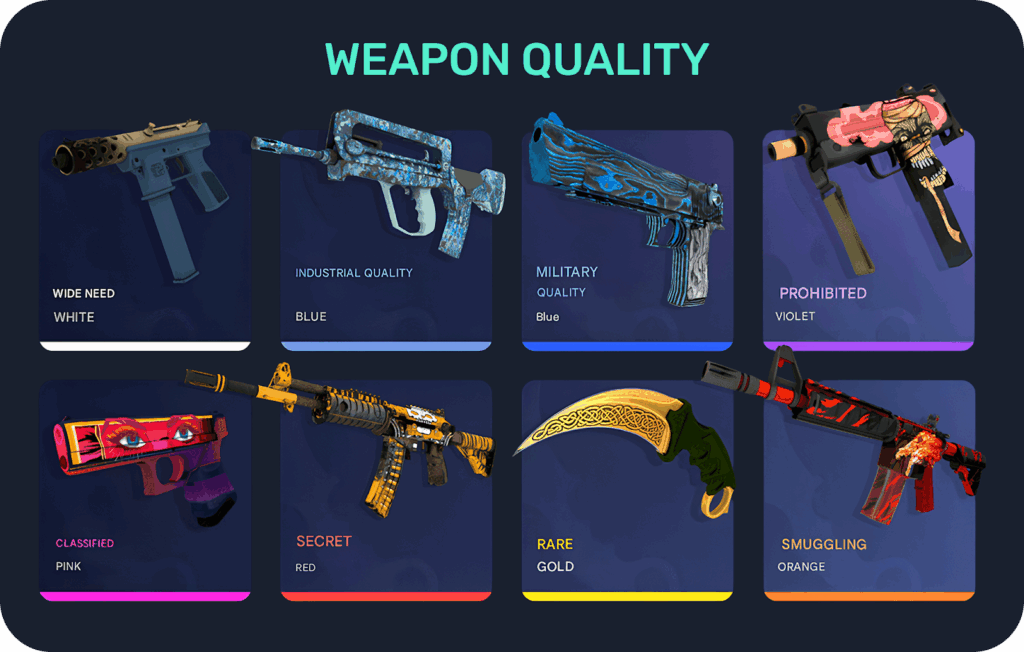
This is the hierarchy set by Valve, marked by colors — from basic Consumer (gray) to elite Contraband (brown). The higher the rarity, the lower the drop chance from a case. That’s what creates the baseline market price.
Quality (Float)
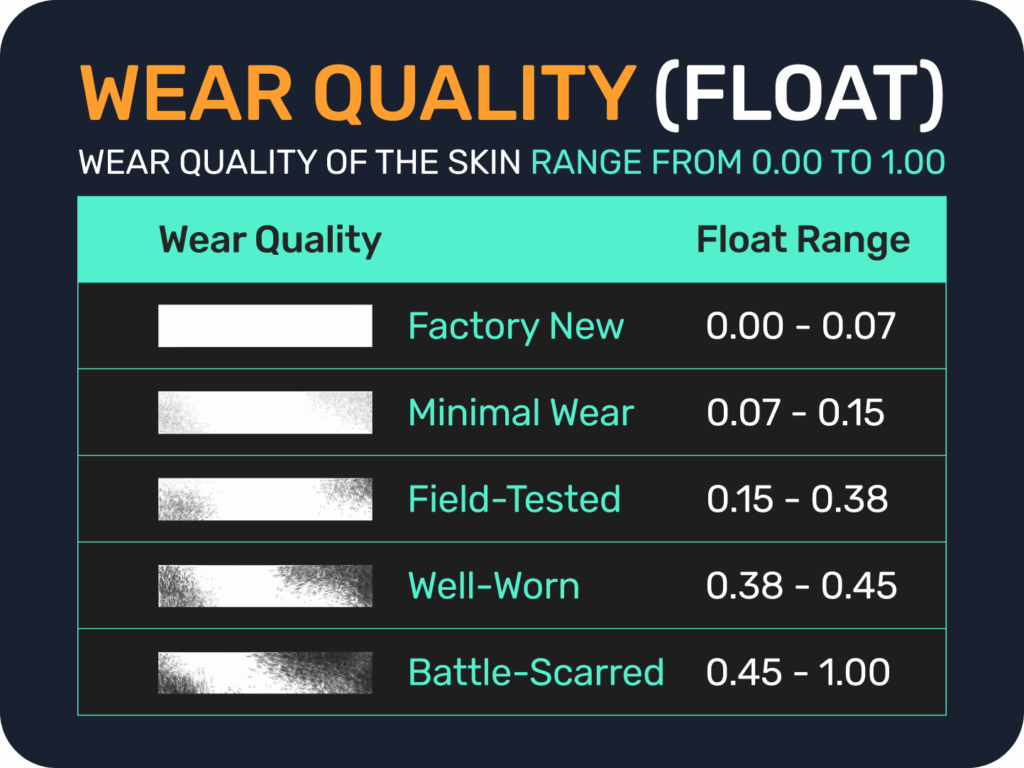
This is a numerical wear value from 0.00 to 1.00. Unlike real-life items, a skin doesn’t degrade from use — it’s “born” with a specific float. Collectors hunt for extremely low-value (low float) weapons that look flawless, or, conversely, for heavily worn versions that develop a unique, darker aesthetic.
Finish Styles
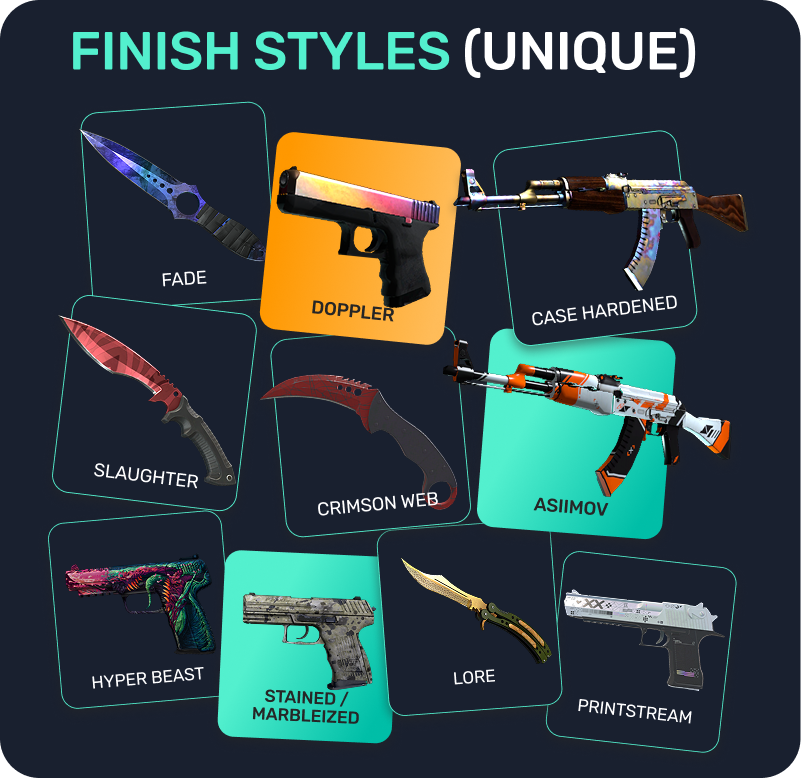
This is the tech bit behind how the design is applied to the weapon. Some skins simply get scratched over time (like paint), others fade or develop a patina (like metal), and some even shift colors entirely.
Pattern index
This is a random number from 1 to 1000 that determines how exactly the texture is applied to the weapon model. This index is what creates legendary Blue Gems on Case Hardened skins. For a casual player, it’s just a pattern, but for a collector, a specific pattern ID can turn a run-of-the-mill knife into a treasure.
Additional parameters
Now let’s do a brief speed-run of secondary attributes:
- StatTrak. A built-in digital counter on the weapon (or etched marks on the body) that tracks how many kills were made with this exact item. It can’t be “boosted” with someone else’s stats, as when sold, the counter resets to zero
- Doppler phases. A unique gradient system that turns a weapon into a shimmering crystal. Fun fact: while usually associated with knives, there’s one exception among firearms — the Glock-18 Gamma Doppler. Collectors split Dopplers into four phases and three ultra-rare variants (Ruby, Sapphire, Emerald)
- Vanilla skins. It’s knives with no painted finish at all — just their original factory steel look
Bonus points: Fun Facts & Legendary Skins in CS
- Around 1,940+ unique skins have been released for CS2 and CS:GO to date
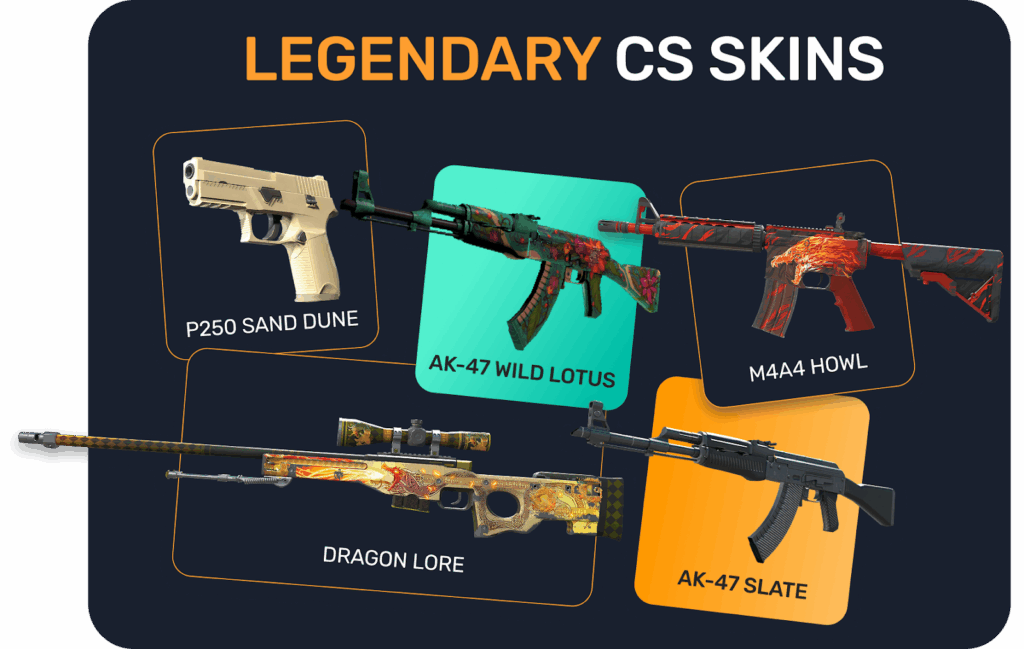
- The popular AK-47 Slate has over 2,000,000+ copies sitting in player inventories
- Every skin has its own pattern index (from 0 to 999). That means 1,000 possible ways a design can appear on a weapon. So yeah, the same AK-47 Wild Lotus, ranging from $4,000 to $25,000+, is totally normal for collectors
- Dragon Lore is the most iconic skin in the world. Souvenir versions with gold stickers from legendary players can go for $150,000 to $450,000+, while regular ones start from $12,000
- There’s only one weapon skin and one sticker in the game with Contraband rarity — M4A4 Howl and Sticker Howling Dawn. The reason is wild: both were accused of using stolen artwork, so Valve redesigned them, removed them from drops, and gave them a unique status
- The community turned the cheapest and “most boring” skin in the game — P250 Sand Dune — into a meme. Players stack thousands of them on a single account, making ironic deals like “trading 5,000 dunes for a knife”
CS Skins: A Universe Inside a Universe
It’s impossible to imagine Counter-Strike without skins today. What started as simple pixel recolors has scaled into a global digital economy with its own rules, auctions, and legends. And this is probably just the beginning: deeper integration with gaming ecosystems, new ownership formats, and even rarer, more valuable items are ahead, shaping the industry’s future.
Want more insights into the gaming world? Jump on board with MOJAM — we know CS like PROs and share our insights like BROs 👀